RRB Station Master Syllabus 2026 and Exam Pattern: Topic Wise (CEN 08/2026)

Updated on 28 October 2026
The RRB Station Master syllabus 2026 has been published inside the CEN No. 08/2026 notification, and the exam pattern of the Computer Based Test (CBT) is given in the same place. The paper has 100 questions to be solved in 120 minutes, and there is negative marking for wrong answers. Candidates who have applied (or planning to apply till 25 November 2026) should first understand how the marks are divided between the sections.
In this article we have given the exam pattern table, the section wise and topic wise syllabus, a simple explanation of each topic, links to our chapters for practice, a note on the CBAT and the answer to the common question about syllabus PDF and Hindi medium. All the details has been taken from the official notification.
Download the official notification (CEN 08/2026):
⬇ Download Notification PDF (English)
⬇ अधिसूचना PDF डाउनलोड करें (हिंदी)
RRB Station Master Syllabus 2026 Highlights
Particulars | Details |
|---|---|
Notification | CEN No. 08/2026 |
Post | Station Master (Level 6) |
Stages | CBT, CBAT, Document Verification, Medical Examination |
Type of Questions | Objective, multiple choice |
Total Questions | 100 |
Duration | 120 minutes |
Negative Marking | 1/3rd of the marks for each wrong answer |
Medium of CBT | English, Hindi and 13 regional languages |
Where the Syllabus Is Given | Para 15.1 of the CEN (Computer Based Test) |
RRB Station Master Exam Pattern 2026
The first stage is a single Computer Based Test. The notification calls the CBT a screening test, and the level of its questions is meant to match the education needed for the post. Marks of this test is used to pick candidates for the CBAT.
Section | Questions | Marks |
|---|---|---|
Basic Science, Mathematical and Analytical Capability | 60 | 60 |
Logical Capability | 20 | 20 |
Mental Reasoning | 20 | 20 |
Total | 100 | 100 |
Exam Duration | 120 minutes (for the whole paper) | |
Negative Marking | 1/3rd mark deducted for each wrong answer |
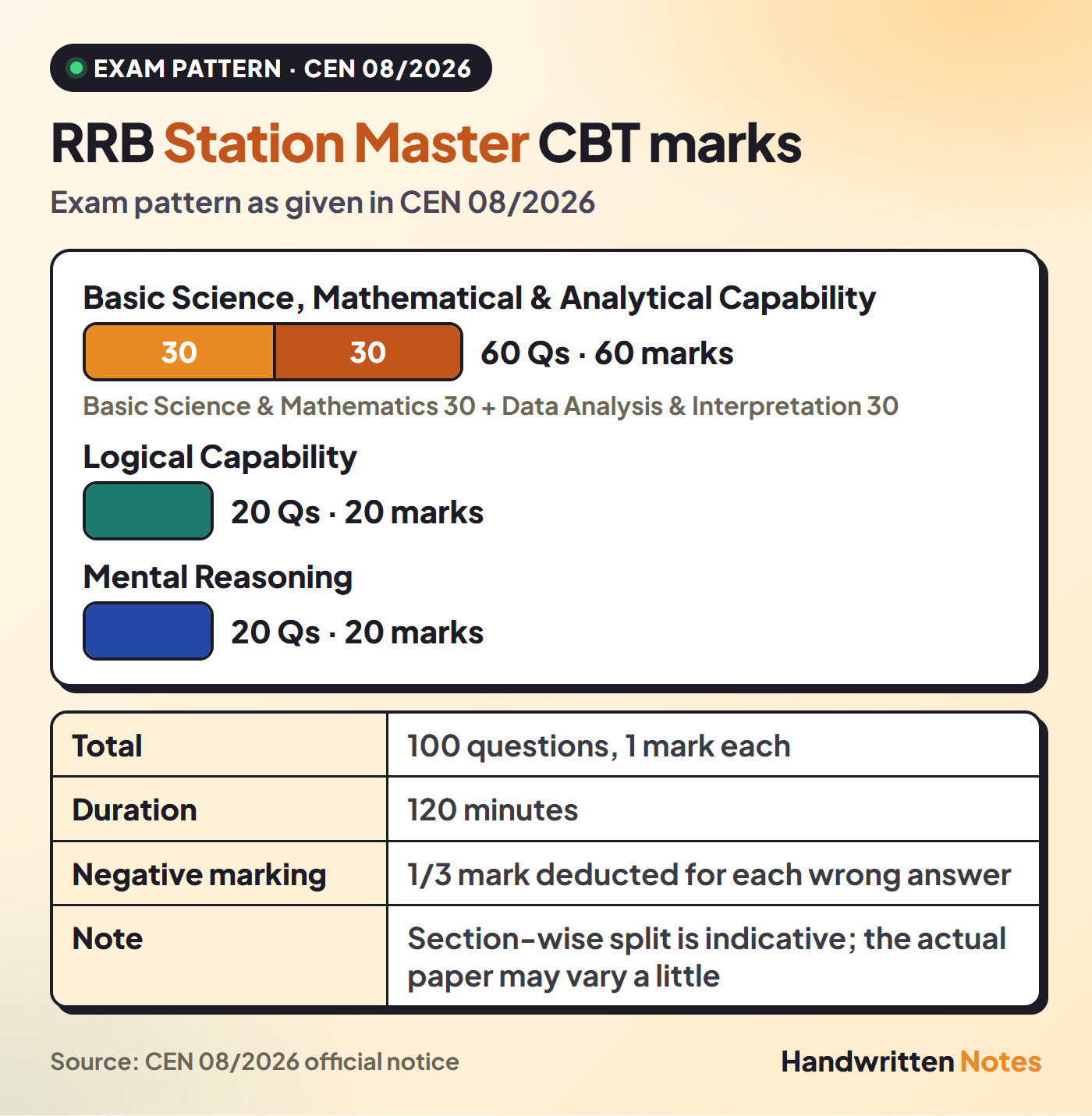
Every question carries 1 mark. The notice gives one total time of 120 minutes and does not fix any separate time for a section, so candidate decides how much time each section gets. The section wise split is only indicative, and the notification itself says that the real question paper may have some variations.
The first section of 60 marks is further divided into two parts of 30 marks each.
Part of the First Section | Marks |
|---|---|
Basic Science and Mathematics | 30 |
Data Analysis and Interpretation | 30 |
Normalisation and Qualifying Marks
If the CBT is held in more than one shift, normalisation of marks will be applied before the shortlisting. The minimum qualifying marks in CBT are different for each community, as given below : The same percentage is applicable for Ex-Servicemen as per their community.
Category | Minimum Qualifying Marks in CBT |
|---|---|
UR | 40% |
EWS | 40% |
OBC (NCL) | 30% |
SC | 30% |
ST | 25% |
RRB Station Master Syllabus 2026 Section Wise
The notification says the questions are "likely to include" the topics below and that the Syllabus is illustrative, not exhaustive. So the candidates should treat it as a base and keep some room for related topics. For the full selection steps, read our article on the RRB Station Master selection process 2026.
Basic Science and Mathematics (30 Marks)
Syllabus as per the notification: Number System, Ratio and Proportions, Averages, Percentages, Profit, Loss and Discounts, Time, Speed, Distance, Power and Work, Algebra, Linear Equations, Arithmetic Progression, LCM, HCF, Geometry and Trigonometry, Area and Volumes, Probability and Statistics (both only basic level), Units, Measurements, Mass, Weight and Density, Work, Power, Energy, Kinetic Energy, Friction, Speed, Velocity, Relative Velocity, Heat and Temperature, Basic Electricity, Levers and Simple Machines.
This part is a mix of school mathematics and school physics. The maths topics are mostly arithmetic, and the science topics are taken from the physics side. Below is a plain explanation of each topic, with our chapter where one is available.
Mathematics Topics
Number System: Questions on types of numbers, divisibility rules and remainders. Practise with Number System: Remainders and Divisibility
Ratio and Proportion: Sharing a quantity in a given ratio, or finding a missing term. See Ratio and Proportion
Averages : Mean of a group, and how it changes when one member is added or removed. See Average
Percentages: Increase, decrease and the percent of a number. It is the base for many other chapters, so see Percentage.
Profit, Loss and Discounts: Cost Price, Selling Price and Marked Price are the three things to keep apart. See Profit and Loss and Discount.
Time, Speed, Distance: Questions use one simple relation between the three quantities, sometimes with trains or boats. See Speed, Time and Distance
Power and Work (as worded in the notice): In an arithmetic paper this is usually the time and work type, where people finish a job together or alone. See Work and Time.
Algebra and Linear Equations: Forming and solving equations with one or two unknowns. See Linear Equations and Algebraic Identities.
Arithmetic Progression: A series in which the gap between two terms stays the same, with questions on the nth term and the sum. See AP and GP (Progressions).
LCM and HCF: Finding the common multiple or common factor, and then using it in word problems. See HCF and LCM
Geometry and Trigonometry: Lines, angles and triangles in geometry, and the ratios of a right triangle in trigonometry. See Plane Geometry: Lines, Angles and Triangles and Trigonometry: Ratios, Standard Values and Identities.
Area and Volumes: Formulas for flat shapes and solid figures. See 2D Mensuration: Area and Perimeter and Volume and Surface Area (3D Mensuration).
Probability and Statistics: The notice says both are at basic level only. That means simple chance questions and mean, median and mode. See Probability and Statistics 1: Data, Mean, Median and Mode.
Science Topics
Units and Measurements: SI units, derived units and how measurement is done. It is covered in the first branch of Mechanics under quantities and units.
Mass, Weight and Density: The difference between mass and weight, and density as mass per unit volume. See Properties of Matter for density, and Mechanics for weight.
Work, Power, Energy and Kinetic Energy: Definitions, units and simple calculations. These are in Mechanics.
Friction: Types of friction and the factors that change it. It is also in Mechanics.
Speed, Velocity and Relative Velocity: Speed has only size, while velocity has direction also. Relative velocity is the speed of one body as seen from another. See Mechanics and Relative Velocity and Relative Speed.
Heat and Temperature: The difference between the two, temperature scales and how heat travels. See Heat and its Transmission
Basic Electricity: Current, voltage, resistance and simple circuits. See Electricity and Magnetism.
Levers and Simple Machines: Types of levers and how a machine makes work easier. Both are in Mechanics.
Data Analysis and Interpretation (30 Marks)
Syllabus as per the notification: Multi-source Data Analysis - examination, analysis and inference drawing from text, tabular data and data represented graphically (charts, graphs, scatter plot, pie chart, statistical curve distribution, Venn Diagrams, Data Sufficiency, Data Arrangement).
This part is worth as many marks as the whole of maths and science, so it is not a small section. The idea is that a candidate reads information given in some form (a paragraph, a table or a graph) and answers from it. Calculation speed matter more than formulas here.
Tables and graphs: Questions based on a data table, bar chart, line graph or a mixed graph. See Data Table, Bar Chart, Line Graph and Mixed Graph.
Pie chart: Each slice is a share of the whole, shown as a percentage or an angle. See Pie Chart
Scatter plot and distribution curves: Points plotted on two axes, and the shape of a distribution. See Scatter Plots, Histograms and Distribution Curves and Statistics 2: Spread, Quartiles and Distribution Shape.
Venn diagrams: Overlapping groups and the number of items in each part. See Logical Venn Diagrams.
Data sufficiency: The questions asks whether the given statements are enough to find the answer, and not the answer itself. See Data Sufficiency.
Data arrangement: Facts about people or things are given in jumbled form and have to be put in order or in a table. See Data Arrangement.
Methods: For a general plan on how to read charts quickly, see Data Interpretation: Methods and Shortcuts.
Logical Capability (20 Marks)
Syllabus as per the notification: Logical Reasoning - Binary Logic, Syllogism, Clocks and Calendars, Assumptions, Blood Relations, Family Tree, solving logic-based puzzles. Reading Comprehension - passages and questions in English language from subjects such as History, Society, Literature, Science, Environment, Abstract, Mythology, Technology and Culture, with questions on the main idea, supporting idea, application, logical structure and style of the paragraph.
The section has two kinds of questions, reasoning and reading. For the reasoning part, every question is solved by careful thinking and not by any formula, therefore regular practice helps most.
Binary Logic: Statements are either true or false, and you work out which combination is possible. See Binary Logic: True and False Statements.
Syllogism: Two or three statements are given, and the candidate decides which conclusion must follow. See Syllogism
Clocks and Calendars: Angle between the hands of a clock, and the day of the week for a date. See Clock and Calendar, and the maths version Clock and Calendar.
Assumptions: A statement is given and you decide what the speaker must be taking for granted. See Statement and Assumptions.
Blood Relations and Family Tree: Relations are described in a chain, and the question asks how two persons are related. A small tree drawn on paper makes this easy. See Blood Relations.
Logic based puzzles: A set of conditions is given and the candidate has to fit people or objects into them. See Puzzles.
Reading Comprehension: A passage in English is followed by questions. The candidate has to find the main point, a supporting point, how an idea is applied, and the structure and style of the writing. See Comprehension. Please note that the notice says these passages will be given in English language.
Mental Reasoning (20 Marks)
Syllabus as per the notification: Analogy - identifying the relationship between two items and applying it to another pair; Series Completion - identifying the pattern in a sequence of numbers and predicting the next term; Coding-Decoding type questions; Ranking and Arrangements based problems.
These are the quicker reasoning questions and they can be solved in less time than the logical ones.
Analogy: Find the link in the first pair and apply the same link to the second pair. See Analogy
Series Completion: The notice speaks of a sequence of numbers, so look for the pattern (a fixed gap, a multiplier, squares and so on). See Number Series, and also Number Series in the maths folder.
Coding-Decoding: A word or number is changed by a rule and you apply the same rule to a new one. See Coding-Decoding.
Ranking and Arrangements: Who stands where in a line or a row, and who sits where around a table. See Number, Ranking and Time Sequence Test and Sitting Arrangement.
Not every chapter is open for everyone, because some of the chapters sit inside our paid passes, while a few (such as Mechanics, Percentage and Coding-Decoding) are free for all. The chapter pages show what is open.
Station Master CBAT Syllabus
The CBAT is not a subject paper, so it does not have a syllabus like the CBT. The notification describes it as an aptitude test, and only the candidates shortlisted from the CBT are called. It does not list topics or the names of the test batteries. What it gives is the following.
Candidate needs a minimum T-Score of 42 in every test battery, and no relaxation is allowed for any category
There is no negative marking in CBAT
The questions and answer options are in English and Hindi only
The original Vision Certificate (Annexure VI or VI A) must be carried to the test, or the entry will not be allowed
For information about the CBAT, the notification points the candidates to the RDSO website (Verticals, then Traffic and Psychology, then Psychology Candidate's Corner)
The final merit list is made with 70% weightage of CBT and 30% weightage of CBAT marks. More about the medical papers is in our article on the railway A-2 medical standard for Station Master.
RRB Station Master Syllabus PDF 2026
There is no separate syllabus PDF for this recruitment, the syllabus is a part of the main notification (CEN No. 08/2026), under the heading Computer Based Test in para 15.1, on printed page 20 of the English PDF. So the official notification PDF is also the syllabus PDF. You can download it from the two links at the top of this page, or from the official RRB website.
RRB Station Master Syllabus in Hindi
The notification has been issued in English and Hindi, and the Hindi PDF is linked above. But the notification also says that if there is any dispute about interpretation, the English version will be treated as final. For the paper, the CBT comes in English, Hindi and 13 other regional languages (Assamese, Bengali, Gujarati, Kannada, Konkani, Malayalam, Manipuri, Marathi, Odia, Punjabi, Tamil, Telugu and Urdu). The candidate chooses one language while applying, and this cannot be changed later. The questions are shown in the chosen language and in English. The only exception stated is the reading comprehension, where the passages will be in English.
RRB Station Master Exam Pattern: Points to Remember
The CBT is single stage, and the shortlisting for the CBAT is done from the normalised CBT marks
For the CBAT the board picks 8 times the number of vacancy (RRB wise), as per the notification
In the final merit the CBT carries 70% weightage and the CBAT carries 30%
Mobile phones, calculators, watches and similar items are not allowed in the Test Centre, and the pen is given there
The exam city, date and shift cannot be changed on request
Last date of the online application is 25.11.2026 (23:59 hrs)
For the numbers of posts RRB wise, see our article on the RRB Station Master vacancy 2026, zone wise, and for the full notification summary see the RRB Station Master recruitment 2026 article.
Prepare with Handwritten Notes
For planning the months before the exam, see the preparation books and study plan article.
Get the RRB Station Master 2026 notes. The RRB Station Master 2026 handwritten notes put the CBT syllabus of CEN 08/2026 into over 270 mind-map chapters, in Hindi and English: Maths and Data Interpretation, Verbal and Logical Reasoning, Physics and Reading Comprehension. One purchase gives 12 months of access, and every chapter opens with a free preview. For every subject on the site, the All Access pass opens all the chapters. For practice, the free RRB NTPC Graduate mock test is a general railway mock (it is not a Station Master paper).
RRB Station Master Syllabus 2026 FAQs
Ques: What is the RRB Station Master syllabus 2026? Ans: The CBT syllabus has three sections, Basic Science, Mathematical and Analytical Capability (60 marks), Logical Capability (20 marks) and Mental Reasoning (20 marks). The topic list is given in para 15.1 of the CEN and is shown above.
Ques: What is the RRB Station Master exam pattern 2026? Ans: The CBT has 100 objective questions of 1 mark each, to be solved in 120 minutes. 1/3rd mark is deducted for every wrong answer.
Ques: How many marks are there in each section? Ans: Yes, the marks distribution is 60 for Basic Science, Mathematical and Analytical Capability, 20 for Logical Capability and 20 for Mental Reasoning. The notification says this split is only indicative.
Ques: Is there a syllabus PDF for RRB Station Master 2026? Ans: No separate file has been released. The syllabus is inside the official CEN 08/2026 notification PDF, in the CBT para.
Ques: Is there a syllabus in Hindi? Ans: Yes, the notification is available in Hindi also, and the CBT questions can be attempted in Hindi (or any of 13 regional languages). The English version is final if there is a dispute, and the reading comprehension passages are in English.
Ques: Is there negative marking in the Station Master exam? Ans: In CBT there is negative marking of 1/3rd mark for each wrong answer. In CBAT there is no negative marking.
Ques: What are the minimum qualifying marks in CBT? Ans: UR and EWS 40%, OBC (NCL) and SC 30%, ST 25%. The same applies to Ex-Servicemen as per their community.
Ques: Is there a syllabus for the CBAT? Ans: The notification does not give a topic list for CBAT. It says a candidate needs a minimum T-Score of 42 in each test battery, and refers candidates to the RDSO website for the details.
Ques: Is the syllabus topic wise or is it only illustrative? Ans: The topics are listed one by one, but the board says the list is illustrative and not exhaustive. A few related topics can also come.
Ques: Which topics have more weightage in the CBT? Ans: The notification does not give any topic wise marks except the split of the first section into 30 marks of Basic Science and Mathematics and 30 marks of Data Analysis and Interpretation.
RRB Station Master Syllabus 2026 Important Links
Official RRB website: rrb.indianrailways.gov.in
Online application: rrbapply.gov.in
Disclaimer: This article is for information only. All the details are based on CEN 08/2026 as available on the date of writing, and the candidates should read the full notification on the official RRB website before applying.
Also Read: More on RRB Station Master 2026
स्टेशन मास्टर सिलेबस 2026 और Exam Pattern (हिंदी में)
RRB Station Master Recruitment 2026: Notification, Vacancy, Eligibility
RRB Station Master Salary 2026: Level 6 Pay and In Hand Salary
How to Apply Online for RRB Station Master 2026
RRB Station Master Selection Process 2026: CBT, CBAT, Merit
RRB Station Master Eligibility 2026: Qualification and Age Limit
Station Master Job Profile 2026: Duties, Uniform and Posting
RRB Station Master Vacancy 2026: RRB Wise and Zone Wise
Railway A-2 Medical Standard for Station Master
RRB Station Master Previous Year Papers and Cut-Off
RRB Station Master vs RRB NTPC 2026
RRB Station Master Preparation: Books and 60 Day Study Plan
 RRB Station Master Vacancy 2026: RRB Wise and Zone Wise (1,265 Posts)
 RRB Station Master vs RRB NTPC 2026: Are They the Same? Differences
 RRB Station Master Syllabus 2026 in Hindi: स्टेशन मास्टर सिलेबस और Exam Pattern