RSSB JE Syllabus 2026: Exam Pattern, 120 Marks, Part A and Part B

Updated on 22 November 2026
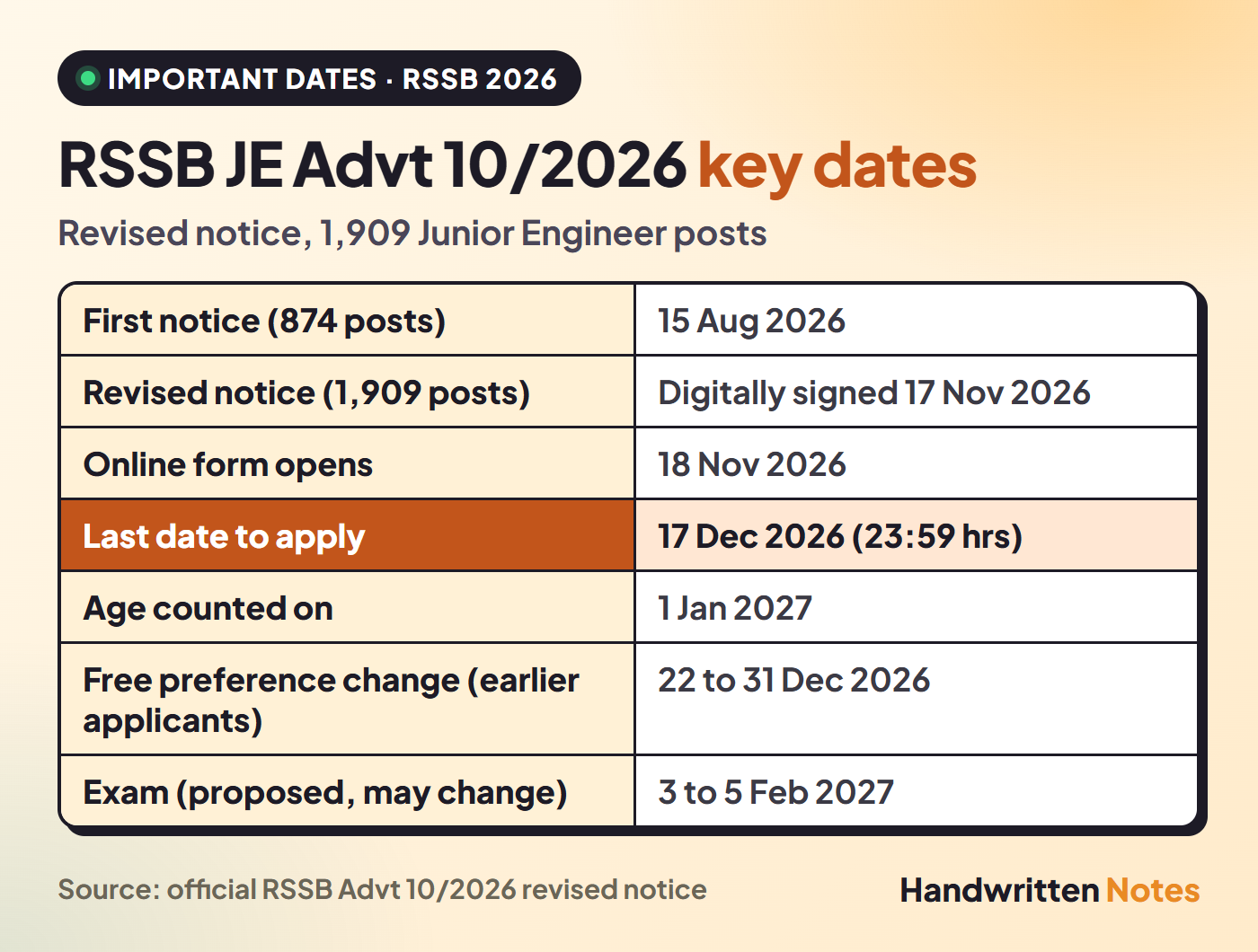
RSSB JE Syllabus 2026 and the Exam Scheme are given in paragraph 23 of the revised Advertisement No. 10/2026 of the Rajasthan Staff Selection Board. The paper has two parts, Rajasthan General Knowledge for 40 marks and the engineering subject of the post for 80 marks, and the notice has printed a separate syllabus for each of the four Junior Engineer cadres. Applications for the 1,909 posts are open till 17 December 2026 (23:59 hrs).
In this article we have given the exam scheme, marking rules, the OMR sheet instructions, the full Part A topics and the Part B topics of every post. Read it with the main RSSB JE Recruitment 2026 article and the eligibility article.
Download the official notification (Advt 10/2026, revised):
⬇ Download Official Notification PDF
RSSB JE Exam Pattern 2026 at a Glance
Detail | What the notice says |
|---|---|
Type of paper | Objective (multiple choice) |
Parts | Part A General Knowledge, Part B engineering subject |
Marks | 40 in Part A and 80 in Part B, total 120 |
Time | 2 hours |
Marks per question | Equal for all questions |
Number of questions | Not given in the notice |
Negative marking | One third (1/3) of the marks of the question for a wrong answer |
Minimum qualifying marks | 40 percent |
Mode | CBT, TBT or offline OMR, proposed to be held separately |
Proposed exam dates | 3 February 2027 to 5 February 2027 |
Language of paper | Not mentioned in the notice |
The same scheme is printed four times, once for each cadre : Civil Degree, Civil Diploma, Mechanical / Electrical Diploma and Electrical Degree. In every one of them, Part A is the same and only Part B changes.
RSSB JE Exam Scheme and Marking 2026
Marks and Qualifying Percentage
As per the notice, the minimum qualifying marks in exam is 40 percent, and a candidate who gets less is not eligible for appointment. The notice does not say that Part A and Part B have separate cut-off marks, and it does not mention any cut-off for selection. So only the 40 percent rule can be quoted from it
The notice also gives a 5 percent relaxation in the minimum qualifying marks to ex-servicemen and to benchmark disability candidates, in the paragraphs on those categories.
Negative Marking
For each wrong answer, one third of the full marks of that question is cut from the total score. A question that is left unanswered does not carry a cut in the normal case, but there is one exception on the OMR sheet as explained below.
OMR Sheet Instructions (Five Options)
The notice has a special instruction for the objective papers of the Board that is checked on an OMR sheet. These are the main points.
Every question will have 5 options, marked A, B, C, D and E. The candidate has to darken only one circle with a blue ball point pen.
Filling one option for each question is compulsory.
If a question is not attempted, the candidate must darken circle E.
If a question is left with all five circles blank, one third of its marks is deducted, but this is done for up to 10 percent of the questions only.
After solving the paper, the Candidate has to check that one circle is filled for every question. An extra 10 minutes beyond the scheduled time is given for this.
A candidate who has left all five circles blank in more than 10 percent of the questions will be disqualified.
The notice also says that the exam can be held as CBT, TBT or OMR, and these OMR instructions relate to the paper-based mode.
Normalisation
If the Board holds the exam in more than one stage, the process of normalisation will be followed. The notice does not explain the formula.
RSSB JE Syllabus 2026 Part A: General Knowledge (40 Marks)
Part A is same for all four cadres. It covers Rajasthan history, art, culture, literature, traditions and heritage, then Rajasthan geography, then the political and administrative system of Rajasthan.
Rajasthan History, Art, Culture, Literature, Traditions and Heritage
Main sources of the history of Rajasthan
Major prehistoric civilisations of Rajasthan
Major dynasties of Rajasthan and their achievements
Mughal-Rajput relations
Main features of architecture
Important forts, monuments and structures
Religious movements of Rajasthan and folk deities
Main paintings, styles and handicrafts of Rajasthan
Rajasthani language and literature: main works, regional dialects
Fairs, festivals, folk music, folk dances, musical instruments and ornaments
Rajasthani culture, tradition and heritage
Important historical tourist places
Major personalities of Rajasthan
Princely states of Rajasthan and British treaties, the people's movement of 1857
Peasant and tribal movements, Praja Mandal movement
Unification of Rajasthan
Political awakening and development of Rajasthan, with special reference to women
Geography of Rajasthan
Location and extent
Main physical divisions: desert region, Aravali hill region, plains, plateau region
Drainage system
Climate
Soil
Natural vegetation
Forest and wildlife conservation
Environmental and ecological issues
Desertification
Agro-climatic regions and main crops
Livestock
Multipurpose projects
Irrigation projects
Water conservation
Transport
Mineral resources
Political and Administrative System of Rajasthan
Local urban self government in Rajasthan
74th Constitution Amendment Bill
Governor, Rajasthan Legislative Assembly, Chief Minister, district administration, Lokayukta
State Human Rights Commission
State Information Commission
State Election Commission
Rajasthan Public Services Guarantee Act, 2011
Note that "current" topics are not named in the list. The list is very wide, and Part A carry half as many marks as Part B, so the topics of History and Geography needs a regular and steady revision.
Free Rajasthan GK Notes for Part A
The Handwritten Notes site has Hindi mind maps on many of these topics, free to open.
History: sources of Rajasthan history, prehistoric civilisations and sites, revolt of 1857, tribal and peasant movements, Praja Mandal and unification
Art and culture: forts, paintings, fairs and festivals, folk deities and language and dialects
Geography: physical divisions, drainage, climate, soils, vegetation, irrigation and minerals
Polity: urban local self government, Governor, Chief Minister and Council of Ministers and district administration
RSSB JE Syllabus 2026 Part B: Junior Engineer (Civil) Degree (80 Marks)
The notice lists 13 subjects for the Civil Degree paper.
No. | Subject | Main topics named in the notice |
|---|---|---|
1 | Building Technology and Construction Management | Building materials (stones, bricks, steel, timber, lime, cement, sand, aggregates, paints, distempers), road materials, construction management with CPM and PERT |
2 | Fluid Mechanics | Properties of fluids, hydrostatics, buoyancy, flow kinematics, Bernoulli equation and its uses, momentum equation, flow through pipes |
3 | Surveying, Estimating, Costing and Field Engineering | Chain and compass surveying, theodolite and traversing, levelling, plane table, contouring, remote sensing and GIS, estimation, rate analysis, tender documents |
4 | Irrigation and Water Resources | Methods of irrigation, hydrology, crop water requirement, canals, weirs and barrages, flood control, land reclamation, major irrigation projects of India |
5 | Theory of Structures and Strength of Materials | Elastic constants, beams, bending moment and shear force, moment of inertia, columns, torsion, springs |
6 | Structural Analysis | Indeterminate structures, slope deflection, moment distribution, unit load method |
7 | Soil Mechanics and Foundation Engineering | Soil properties and classification, permeability, consolidation, shear strength, compaction, earth pressure, bearing capacity |
8 | Design of RC Concrete and Masonry Structures | RCC beams, slabs, footings, columns, staircases, retaining walls, water tanks, concrete technology |
9 | Design of Steel Structures | Design of steel columns, beams, roof trusses and plate girders |
10 | Construction Technology | Stone and brick masonry, lintels, roofing, flooring, plastering, centering and shuttering |
11 | AutoCAD Civil Engineering Drawing | Named as a subject without sub-topics |
12 | Public Health Engineering | Water supply, purification, drainage and sewerage systems, sewage treatment, urban sanitation |
13 | Highway and Bridges | Highway planning, flexible pavements, traffic engineering, alignment, pavement design, maintenance of roads |
The Fluid Mechanics, Surveying, Irrigation and Structural subjects have longest lists in the PDF. Candidates should read pages 25 to 29 of the notification for every sub-topic, because the above table is a summary.
RSSB JE Syllabus 2026 Part B: Junior Engineer (Civil) Diploma (80 Marks)
Seven subjects are given for the diploma paper.
Building Technology and Construction Management: properties (physical and chemical), classification, tests and uses of building stones, silicate based materials, Portland cement, asbestos products, timber and wood based products, laminates, bituminous materials, paints and varnishes, with how some of them are made
Surveying, Estimating and Costing: chain surveying, prismatic compass, plane table, theodolite, levelling, contouring, curve setting, earthwork calculation, estimates of buildings, septic tank, pavements and tube well, bar bending schedule, valuation
Strength of Materials: elastic constants, beams, bending moment and shear force diagrams, moment of inertia, columns, torsion of circular section
Reinforced Concrete Design: RCC beams, T-beams, lintels, slabs, footings, columns, staircases, retaining wall, water tanks (limit state and working stress methods)
Irrigation and Water Resources
Soil Engineering
AutoCAD Civil Engineering Drawing
RSSB JE Syllabus 2026 Part B: Junior Engineer (Mechanical / Electrical) Diploma (80 Marks)
The scheme heading of this cadre is Mechanical / Electrical (Diploma), and the notice gives two lists under it, one for Electrical Engineering (Diploma) and one for Mechanical Engineering (Diploma). A candidate should follow the list of his own branch
Electrical Engineering (Diploma)
Basic concepts: resistance, inductance, capacitance, current, voltage, power, energy
Circuit laws: Kirchhoff's laws, network theorems
Magnetic circuits
AC fundamentals: R.M.S. and average values, series and parallel AC circuits, resonance, star and delta connection, three phase power
Measurement and measuring instruments
Electrical machines: DC machines, single and three phase transformers, three phase induction motors, fractional kilowatt and single phase induction motors
Synchronous machines
Generation, transmission and distribution: power stations, load factor, tariffs, faults, switchgear, protection, cables
Estimation and costing
Utilisation of electrical energy: illumination, heating, welding, electroplating, drives
Basic electronics: diodes, transistors, simple circuits
Mechanical Engineering (Diploma)
Fluid Mechanics
Fluid Machines: turbines, centrifugal and reciprocating pumps, hydraulic machines
Internal Combustion Engines: four stroke and two stroke cycle, petrol and diesel engines, cooling and lubrication, performance, gas turbines, air compressors
Strength of Materials: stress and strain, Mohr's circle, strain energy, bending moment and shear force, bending and shear stresses, deflection, columns and struts, torsion, springs, thin cylinders
Theory of Machines: mechanisms, velocity and acceleration, friction, transmission of power, balancing, vibration, governors, brakes and dynamometers, gyroscope
AutoCAD Mechanical Engineering Drawings
Thermodynamics: gas laws, laws of thermodynamics, steam and its properties, boilers, gas power cycles
Machine Drawings
RSSB JE Syllabus 2026 Part B: Junior Engineer (Electrical) Degree (80 Marks)
Ten subjects are printed for this cadre.
Electrical Circuits: network analysis, theorems, transient response, resonance, three phase networks
Field Theory: electrostatics, magnetostatics, Maxwell's equations, electromagnetic waves
Electrical Materials
Electrical Measurement and Instrumentation: measuring instruments, transducers, digital meters
Electronics and Communication: diodes, transistors, amplifiers, rectifiers, AM and FM
Power Electronics: thyristor, triac, converters, choppers
Control System: open and closed loop systems, time and frequency response, stability, state space
Electrical Machines: transformers, single phase and three phase induction motors, alternators, synchronous motors
Power Systems: generation, transmission line parameters, performance of lines, cables, corona, insulators, HVDC
Switchgear and Protection: arc extinction, circuit breakers, relays, protection of lines, transformers and generators
RSSB JE Exam Day Rules 2026
The Admit Card is issued online, on the SSO login and the Recruitment Portal. The Board does not send it by post.
Candidates should bring a transparent blue ball pen, one photograph of 2.5 cm by 2.5 cm (not older than one month), one original photo identity card and the e-admit card. Mobile phone and purse are not to be brought into the exam hall.
The photo and signature on the admit card must match the ones uploaded in the form, or the candidate may be disqualified.
Mobile phones, pagers, Bluetooth and other communication devices are not permitted inside the exam premises.
The Board's dress code applies to all candidates, and its details are on the website.
After the exam, the question paper and the answer key are put on the Board's website, and objections are invited. Each objection costs Rs. 100/-, and the process will be told in a separate notice.
Use of unfair means can lead to action under the Rajasthan Public Examination (Measures for Prevention of Unfair Means in Recruitment) Act, 2022.
RSSB JE Syllabus 2026 FAQs
Q1. What is the exam pattern of RSSB JE 2026 ? One objective paper of 120 marks and 2 hours, with 40 marks of General Knowledge of Rajasthan (Part A) and 80 marks of the engineering subject (Part B). The notice gives no count of questions.
Q2. Is there negative marking in RSSB JE? Yes. One third of the marks of a question is cut for a wrong answer. On the OMR sheet, circle E is to be filled for a question not attempted.
Q3. What are the minimum qualifying marks in RSSB JE 2026? 40 percent, as per the notice. The notice does not mention any selection cut-off.
Q4. Is the Rajasthan GK syllabus the same for civil, electrical and mechanical? Yes, the Part A topics are common for all four cadres, and the Part B only is different.
Q5. Is current affairs in the RSSB JE syllabus? Current affairs are not named in the printed syllabus. The Part A list has history, art and culture, geography and polity and administration of Rajasthan.
Q6. When is the RSSB JE exam? The notice proposes 3 February 2027 to 5 February 2027, and it says that the Board can change the dates. It will inform on its website.
Q7. Is the exam CBT or OMR? The notice says it can be CBT, TBT or offline OMR, held separately. The mode for each post is not fixed in the notice.
Q8. Which Part B syllabus is for Mechanical Diploma candidates? The Mechanical Engineering (Diploma) list with eight subjects, from Fluid Mechanics to Machine Drawings.
Important Links
Official website of the Board: rssb.rajasthan.gov.in
Recruitment portal: recruitment.rajasthan.gov.in
Official notification PDF (Advt 10/2026, revised): use the download button at the top
Prepare with Handwritten Notes
For the 40 marks of Part A, practise with the free mock tests and the previous year papers, and keep an eye on the current affairs page for Rajasthan news. All the Hindi Rajasthan notes are on the mind map page, and the All Access pass opens every map. Also see the salary article of this series.
Candidates should read the official notification and check the official website before applying; dates and details may change.
Also Read: More on RSSB JE 2026
RSSB JE Recruitment 2026: 1,909 Posts, Advt 10/2026 Apply Online
RSSB JE Eligibility 2026: Age Limit, Degree, Diploma, Relaxation
RSSB JE Salary 2026: Pay Level 10, Probation Pay and Benefits
RSSB JE Apply Online 2026: Step by Step Form, Fee, Photo Size
 RSSB JE Apply Online 2026: Step by Step Form, Fee, Photo Size
 RSSB JE Recruitment 2026: 1,909 Posts, Advt 10/2026 Apply Online
 RSSB JE Eligibility 2026: Age Limit, Degree, Diploma, Relaxation
