APPSC Group 2 Syllabus 2026 and Exam Pattern: Screening Test, Mains, CPT

Updated on 22 November 2026
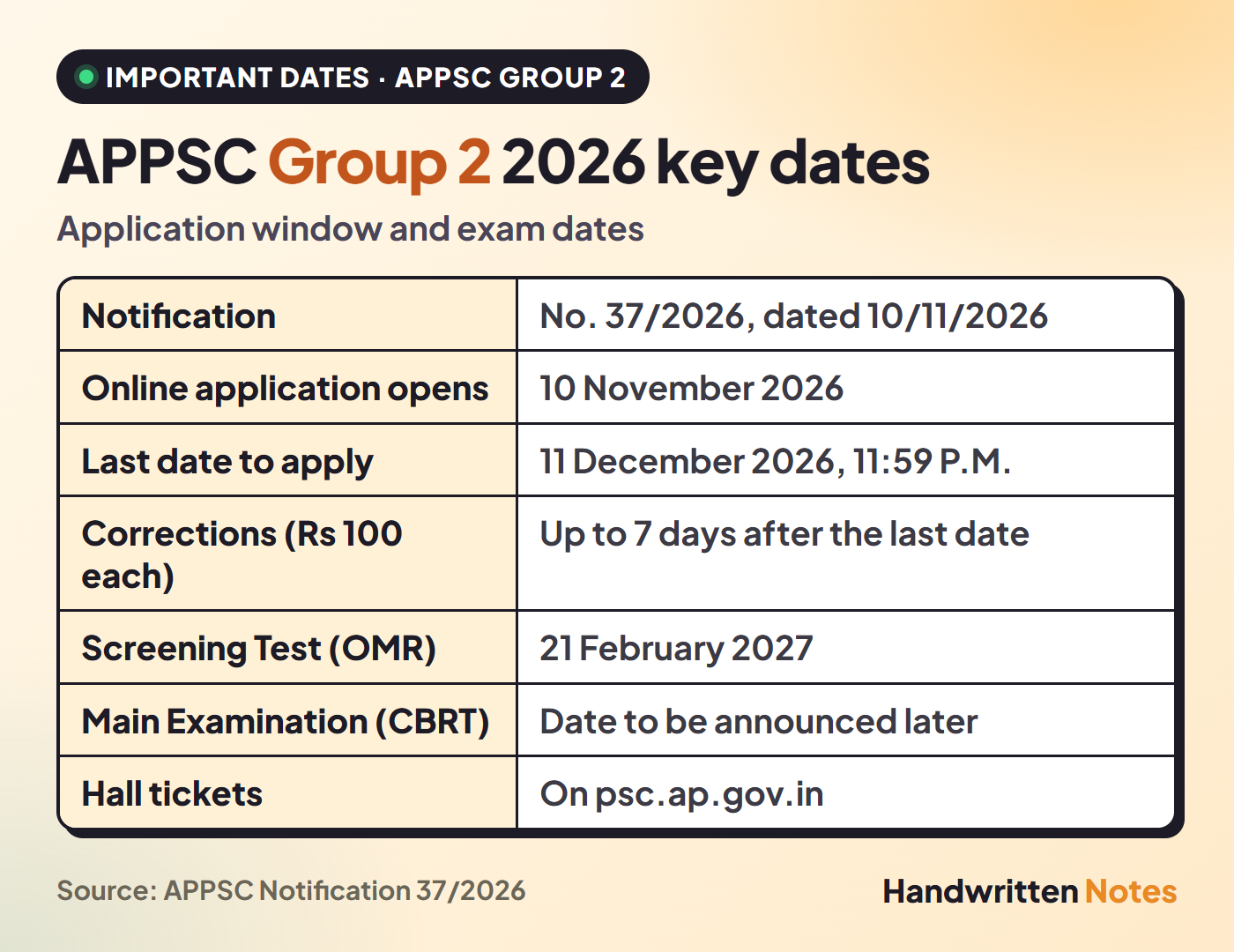
The APPSC Group 2 syllabus 2026 and exam pattern is given in Annexure-II of Notification No. 37/2026, which was released by the Andhra Pradesh Public Service Commission on 10/11/2026. There are three stages: a Screening Test of 150 marks, a Main Examination of 300 marks (Paper I and Paper II) and a Computer Proficiency Test. Applications are open on https://psc.ap.gov.in up to 11/12/2026, 11:59 P.M.
In this article we have given the stage wise scheme, marks, negative marking, qualifying marks, the full topic list of the Screening Test and of both Main papers, the CPT scheme and the exam day rules. Vacancy and fee details are in the APPSC Group 2 Recruitment 2026 article.
⬇ Download Official Notification PDF
APPSC Group 2 Exam Pattern 2026 at a Glance
Particulars | Details |
|---|---|
Notification | 37/2026 dated 10/11/2026 |
Stages | Screening Test, Main Examination, Computer Proficiency Test (CPT) |
Screening Test Mode | Objective type, offline, OMR based |
Main Examination Mode | Objective type, Computer Based Recruitment Test (CBRT) |
Standard | Degree standard |
Negative Marking | 1/3rd of the marks of the question for each wrong answer |
Screening Test Date | 21 February 2027 |
Main Examination Date | To be announced later |
Language of Question Paper | English, translated into Telugu; the English version is authentic for valuation |
The notice says the scheme and syllabus follow G.O.Ms.No.06, Finance (HR-I Plg & Policy) Dept. dated 06.01.2023. The scheme for the CPT is as per G.O.Ms.No.26, G.A. (Ser.B) Dept. dated 24.02.2023.
APPSC Group 2 Selection Process 2026
Screening Test. One paper (GSMA), meant only for shortlisting. Candidates equal to 50 times the vacancies, whatever the community, move on to the Main Examination.
Main Examination. Two papers, both objective type. A candidate must appear in the Screening Test and in all the papers of the Main Examination, and absence in any paper makes the candidate liable to disqualification.
Computer Proficiency Test. After the Main Examination a provisional shortlist is drawn in the Commission's ratio, and these candidates must pass the CPT as per Rule 14A of the A.P. State and Subordinate Service Rules, 1996.
Selection. The selection for appointment is based on merit in the Main Examination, on the condition that the candidate qualifies the CPT. The appointment is also subject to the candidate being found medically fit.
The notice give the Commission power to pick candidates with the minimum qualifying marks it fixes in the Screening Test. It may also apply relaxed standards for SC, ST, BC and physically challenged candidates in the Screening Test, if it feels that not enough candidates from these communities will qualify under the general standard. There is no interview in the notice.
Minimum Qualifying Marks (Aggregate)
Category | Minimum Marks |
|---|---|
OC and EWS | 40% |
Backward Class | 35% |
SCs, STs and PBDs | 30% |
The notice adds that merely securing the minimum marks does not give any right to be considered for selection. When SC and ST candidates do not reach the minimum, they are taken by rank in the written examination, whatever marks they scored.
Tie in Marks
A tie in the total marks of the Main Examination is broken by age, and the older person gets the higher place. If age is also equal, the earlier date of getting the educational qualification counts. Where a post has a Preferential qualification, that comes before age.
APPSC Group 2 Screening Test Pattern 2026
Paper | Subject | Questions | Duration | Maximum Marks |
|---|---|---|---|---|
One paper | General Studies & Mental Ability | 150 | 150 minutes | 150 |
Total | 150 |
The five parts of paper carry 30 marks each : Indian History, Geography, Indian Society, Current Affairs and Mental Ability.
APPSC Group 2 Main Examination Pattern 2026
Paper | Subjects | Questions | Duration | Maximum Marks |
|---|---|---|---|---|
Paper I | 1. Social History of Andhra Pradesh, i.e., the history of Social and Cultural Movements in Andhra Pradesh. 2. General overview of the Indian Constitution | 150 | 150 minutes | 150 |
Paper II | 1. Indian and AP Economy. 2. Science and Technology | 150 | 150 minutes | 150 |
Total | 300 |
Each paper has two sections of 75 marks, as shown in the syllabus below. In the Screening Test and in both Main papers a wrong answer is penalised with 1/3rd of the question's marks. If any question is deleted from a paper, the marks of that part are scaled in proportion up to the maximum marks of the paper and rounded off to 2 decimals.
Normalisation
Where the computer based tests run in several sessions, the Commission normalises the scores to take care of differences between the papers, and the results come out in percentile form. The notice (Annexure-V) says that normalised marks are calculated up to 5 decimal places, can vary from the absolute marks, and only the normalised marks are used for the General Ranking List.
APPSC Group 2 Syllabus 2026: Screening Test (General Studies and Mental Ability, 150 Marks)
Indian History (30 Marks)
Ancient History: Indus Valley Civilization and Vedic age (salient features), emergence of Buddhism and Jainism, Mauryan and Gupta empires (administration, socio-economic and religious conditions, art and architecture, literature), Harshavardhana and his achievements.
Medieval History: Chola administrative system, Delhi Sultanate and the Mughal Empire (administration, socio-economic and religious conditions, art and architecture, language and literature), Bhakti and Sufi Movements, Shivaji and the rise of the Maratha Empire, advent of Europeans.
Modern History: 1857 Revolt and its impact, rise and consolidation of British power in India, changes in administration, social and cultural spheres, social and religious reform movements of the 19th and 20th century, the Indian National Movement with its stages, contributors and contributions from different parts of the country, post independence consolidation and reorganization within the country.
Geography (30 Marks)
General and Physical Geography: The Earth in our Solar System, interior of the Earth, major landforms and features, climate (structure and composition of atmosphere), ocean water (tides, waves, currents), India and Andhra Pradesh (physiographic features, climate, drainage system, soils and vegetation), natural hazards and disasters and their management.
Economic Geography of India and AP: Natural resources and distribution, agriculture and agro based activities, distribution of major industries and industrial regions, transport, communication, tourism and trade.
Human Geography of India and AP: Human development, demographics, urbanization and migration, racial, tribal, religious and linguistic groups.
Indian Society (30 Marks)
Structure of Indian Society: Family, marriage, kinship, caste, tribe, ethnicity, religion and women.
Social Issues: Casteism, communalism and regionalisation, crime against women, child abuse and child labour, youth unrest and agitation.
Welfare Mechanism: Public policies and welfare programmes, constitutional and statutory provisions for Scheduled Castes, Scheduled Tribes, Minorities, BCs, Women, Disabled and Children.
Current Affairs (30 Marks)
Major current events and issues pertaining to International, National and the State of Andhra Pradesh.
Mental Ability (30 Marks)
Logical Reasoning (Deductive, Inductive, Abductive): Statement and assumptions, statement and argument, statement and conclusion, statement and courses of action.
Mental Ability: Number series, letter series, odd man out, coding-decoding, problems relating to relations, shapes and their sub sections.
Basic Numeracy: Number system, order of magnitude, averages, ratio and proportion, percentage, simple and compound interest, time and work, time and distance. Data analysis (tables, bar diagram, line graph, pie-chart).
APPSC Group 2 Syllabus 2026: Main Examination Paper I (150 Marks)
Section A: Social and Cultural History of Andhra Pradesh (75 Marks)
Pre-historic cultures, the Satavahanas, the Ikshvakus (socio-economic and religious conditions, literature, art and architecture), the Vishnukundins, the Eastern Chalukyas of Vengi and the Andhra Cholas (society, religion, Telugu language, art and architecture).
Major and minor dynasties that ruled Andhradesa between the 11th and 16th centuries A.D., their socio-religious and economic conditions, growth of Telugu language and literature, art and architecture of the same period.
Advent of Europeans, trade centres, Andhra under the Company, 1857 Revolt and its impact on Andhra, establishment of British rule, socio-cultural awakening, Justice Party and Self Respect Movement, growth of the nationalist movement in Andhra between 1885 and 1947, role of Socialists and Communists, anti-zamindari and Kisan movements, nationalist poetry, revolutionary literature, Nataka Samasthalu and women participation.
Origin and growth of the Andhra Movement, role of Andhra Mahasabhas, prominent leaders, events leading to the formation of Andhra State in 1953, role of the press and newspapers, the Library Movement and folk and tribal culture.
Events leading to the formation of Andhra Pradesh State, Visalandhra Mahasabha, States Reorganization Commission and its recommendations, Gentlemen's Agreement, important social and cultural events between 1956 and 2014.
Section B: Indian Constitution (75 Marks)
Nature of the Indian Constitution, constitutional development, salient features, Preamble, Fundamental Rights, Directive Principles of State Policy and their relationship, Fundamental Duties, amendment of the Constitution, basic structure.
Structure and functions of Indian government: legislative, executive and judiciary, unicameral and bicameral legislatures, parliamentary executive, judicial review, judicial activism.
Distribution of legislative and executive powers between the Union and the States, legislative, administrative and financial relations, powers and functions of constitutional bodies, Human Rights Commission, RTI, Lokpal and Lok Ayukta.
Centre-State relations and the need for reforms (Rajmannar Committee, Sarkaria Commission, M.M. Punchchi Commission), unitary and federal features, political parties and the party system, recognition of national and State parties, elections and electoral reforms, Anti-Defection Law.
Centralization versus decentralization, Community Development Programme, Balwant Rai Mehta and Ashok Mehta Committees, 73rd and 74th Constitutional Amendment Acts and their implementation.
APPSC Group 2 Syllabus 2026: Main Examination Paper II (150 Marks)
Section A: Indian and AP Economy (75 Marks)
Structure of Indian Economy, Economic Planning and Policy: national income (concept and measurement), occupational pattern and sectoral distribution of income, economic growth and development, strategy of planning, new economic reforms 1991, decentralization of financial resources, NITI Aayog.
Money, Banking, Public Finance and Foreign Trade: functions and measures of money supply, RBI (functions, monetary policy and control of credit), Indian banking (structure, development, reforms), inflation, fiscal policy (fiscal imbalance, deficit finance, fiscal responsibility), tax structure, GST, recent Indian Budget, balance of payments, FDI.
Agricultural, Industrial and Services Sectors in Indian Economy: cropping pattern, agricultural production and productivity, agricultural finance and marketing, pricing and policy (MSP, procurement, issue price, distribution), industrial development, New Industrial Policy 1991, disinvestment, ease of doing business, industrial sickness, growth of the services sector, IT and ITES industry.
Structure of Andhra Pradesh Economy and Public Finance: GSDP and sectoral contribution, per capita income, State revenue (tax and non-tax), expenditure, debts and interest payments, central assistance, externally aided projects, recent AP Budget.
Agriculture and Allied Sector, Industrial Sector and Services Sector of Andhra Pradesh: production trends, cropping pattern, rural credit and cooperatives, agricultural marketing, schemes for horticulture, animal husbandry, fisheries and forests, growth and structure of industries, recent AP Industrial Development Policy, single window mechanism, incentives, MSMEs, industrial corridors, services sector, IT, electronics and communications, recent AP IT Policy.
Section B: Science and Technology (75 Marks)
Technology Missions, Policies and Applications: national S&T policy, emerging technology frontiers, space technology (launch vehicles, recent satellite launches and applications, space science missions), defence technology (DRDO structure, vision and mission, technologies developed, IGMDP), ICT (National Policy on Information Technology, Digital India Mission, e-governance, cyber security concerns, National Cyber Security Policy), nuclear technology (Indian reactors and power plants, applications of radioisotopes, India's nuclear programme).
Energy Management: installed energy capacities and demand in India, National Energy Policy, National Policy on Biofuels, Bharat Stage norms, non-renewable and renewable energy sources and installed capacities, new initiatives and recent programmes in the renewable energy sector.
Ecosystem and Biodiversity: basic concepts of ecology, ecosystem components and types, biodiversity (meaning, components, hotspots, loss and conservation, recent plans, targets, conventions and protocols), wildlife conservation (CITES, endangered species with reference to India), biosphere reserves, Indian wildlife conservation efforts, projects and acts.
Waste Management and Pollution Control: solid waste (classification, disposal and management in India), types, sources and impacts of environmental pollution, pollution control and regulation, impact of transgenics on environment and their regulation, eco-friendly technologies in agriculture, bioremediation.
Environment and Health: global warming, climate change, acid rain, ozone layer depletion, ocean acidification, recent international initiatives, protocols and conventions on climate change with India's role, sustainable development (meaning, nature, scope, components, goals), health issues (disease burden, epidemic and pandemic challenges), preparedness and response, healthcare delivery and outcomes, recent public health initiatives and programmes.
APPSC Group 2 Computer Proficiency Test (CPT) 2026
Test | Duration | Maximum Marks | Minimum Qualifying Marks |
|---|---|---|---|
Proficiency in Office Automation with usage of Computers and Associated Software (practical type) | 60 minutes | 100 | SC/ST/PBD 30, BCs 35, OCs 40 |
Part A covers: introduction to computers (components, input and output devices, storage, RAM, ROM, control unit, ALU), types of computer software, operating system, Windows operating system (GUI, files and folders, peripheral set up), Linux and Mac OS (basic concepts only), internet concepts, electronic mail, and the World Wide Web (basic concepts only).
Part B covers the office suite (MS Office or an open source suite such as Libre Office), file operations, tools in office applications, word processing, spreadsheet and presentation software.
Assessment Component | Share of Total Marks |
|---|---|
Part A: MCQs | 20% |
Part B: typing speed test (can be made compulsory for qualifying under existing norms) | 25% |
Part B: organizing and inserting different objects | 15% |
Part B: preparing an Excel sheet (formatting, merge/split, formulae, conditional formatting, graphs) | 20% |
Part B: preparing a PowerPoint presentation (layouts, formatted text, images, tables, transitions, animation) | 20% |
The first item of Part B, preparing a model document in a formatted manner (tables, images or WordArt, mail merge), has no separate percentage in notice.
Exam Centres and Exam Day Rules
Both tests are planned at every district centre. A candidate gives three preferences for the Screening Test and three for the Main Examination, and the Commission may allot any centre as per availability. Centres for both tests must be indicated in the online application.
Hall Tickets for both tests will be hosted on https://psc.ap.gov.in.
For the OMR Test, use a blue or black ball point pen only. The Question Paper Booklet series must be bubbled correctly, otherwise the sheet is not evaluated. Whitener, eraser or blade use leads to invalidation, and double bubbled answers get negative marks instead of zero.
For the online test, biometric identification is done before entry, the password is announced 15 minutes before the start, and the Submit button becomes active after 150 Minutes.
Mobile phones, smart watches, pen drives, cameras and Bluetooth devices are banned, even in switched off mode. On calculators the notice is not consistent: Para 16.5.1 bans any calculator, while the general instruction D.4 allows non-programmable calculators wherever necessary. It is safer to go without one.
The Commission publish the initial answer key on its website. Objections can be filed within three days of publication in the prescribed proforma, at Rs 100 per objection, which is returned if the objection is sustained. The final key is fixed after three subject experts examine the objections.
Prepare with Handwritten Notes
Many topics in this syllabus matches the free chapters on the site. For the Main Paper I constitution part the notes on the Preamble, Fundamental Rights and Centre-State relations are useful, and for Paper II economy the chapters on NITI Aayog and planning, RBI and monetary policy and GST can be used. The mental ability part can be practised with number series and coding-decoding. There are no Andhra Pradesh history chapters on the site at present, so for that section candidates need other books. Free mock tests and the current affairs pages are also there, and the All Access pass opens every chapter.
APPSC Group 2 Syllabus 2026 Important Links
Official website: https://psc.ap.gov.in
Official notification PDF (syllabus is in Annexure-II): download button at the top of this article
Eligibility and age: APPSC Group 2 eligibility article
Pay scales: APPSC Group 2 salary article
Form steps: apply online guide
APPSC Group 2 Syllabus and Exam Pattern 2026 FAQs
Q1. What is the exam pattern of APPSC Group 2 2026? There is a Screening Test of 150 marks, a Main Examination of two papers of 150 marks each (300 in total), and then a Computer Proficiency Test. The first test uses OMR sheets and the Mains is taken on computer.
Q2. Is there negative marking in the APPSC Group 2 exam? Yes. For every wrong answer, one third of the marks of the question is cut, in the Screening Test and in both Main papers.
Q3. What is the APPSC Group 2 Screening Test date? 21 February 2027. The Main Examination date is not announced yet and will be put on Commission's website later.
Q4. How many questions come in the APPSC Group 2 Screening Test? The paper has 150 questions for 150 marks, and the time is 150 minutes. The subjects are History, Geography, Indian Society, Current Affairs and Mental Ability, 30 marks each.
Q5. What is in APPSC Group 2 Main Paper I and Paper II? Paper I is about the social and cultural movements of Andhra Pradesh plus a broad look at the Constitution. Paper II carries economy (India and AP) and science and technology.
Q6. How many candidates are called for the Main Examination? The notice says 50 times the number of vacancies, irrespective of communities, based on the Screening Test.
Q7. Do the Screening Test marks count in the final selection? No. The Screening Test is only for shortlisting. The selection for appointment is based on merit in the Main Examination, with the CPT to be qualified.
Q8. What is the minimum qualifying mark for APPSC Group 2? It is 40% for OC and EWS, 35% for Backward Class and 30% for SCs, STs and PBDs, in aggregate. For the CPT, out of 100, the minimum is 40 for OCs, 35 for BCs and 30 for SC/ST/PBD.
Disclaimer: The syllabus here is summarised from Annexure-II of the notification, so for the exact wording candidates should use the official PDF. Dates and schemes may change through a later notice.
Also Read: More on APPSC Group 2 2026
APPSC Group 2 Recruitment 2026: 720 Posts, Notification 37/2026, Apply
APPSC Group 2 Eligibility 2026: Age Limit 18-44, Qualification, Post Wise
APPSC Group 2 Salary 2026: Pay Scale by Post, Rs 25,220 to Rs 1,30,580
How to Apply for APPSC Group 2 2026: Online Form Step by Step, OTPR, Fee
 APPSC Group 2 Recruitment 2026: 720 Posts, Notification 37/2026, Apply
 APPSC Group 2 Salary 2026: Pay Scale by Post, Rs 25,220 to Rs 1,30,580
 APPSC Group 2 Eligibility 2026: Age Limit 18-44, Qualification, Post Wise
